

Rated 4.7 out of 5 stars
4.7 / 5


726,000+ customers
Free 60-Day Returns
1-Year Warranty
726,000+ customers
Free 60-Day Returns
1-Year Warranty

Red light therapy while breastfeeding should start only after your OB-GYN, dermatologist, or another qualified clinician clears the device and treatment area. In 2026, the safest approach is to follow the device instructions, treat intact facial skin, avoid direct use on the breasts or nipples, review every topical separately, and stop if your skin reacts.
Breastfeeding changes the safety question. Light is not a medication that passes into breast milk, but red and near-infrared light can affect treated tissue. Direct breast exposure has not been studied well enough to declare it safe for every nursing parent.
Postpartum skin can also become dry, sensitive, acne-prone, or affected by pigmentation. Those postpartum skin changes may alter how your skin responds to a device or the products used with it.
Solawave sells FDA-cleared red light therapy skincare devices, but FDA clearance for an intended use does not automatically establish safety during breastfeeding. Your clinician still needs to assess your recovery, medications, skin condition, and planned treatment area.
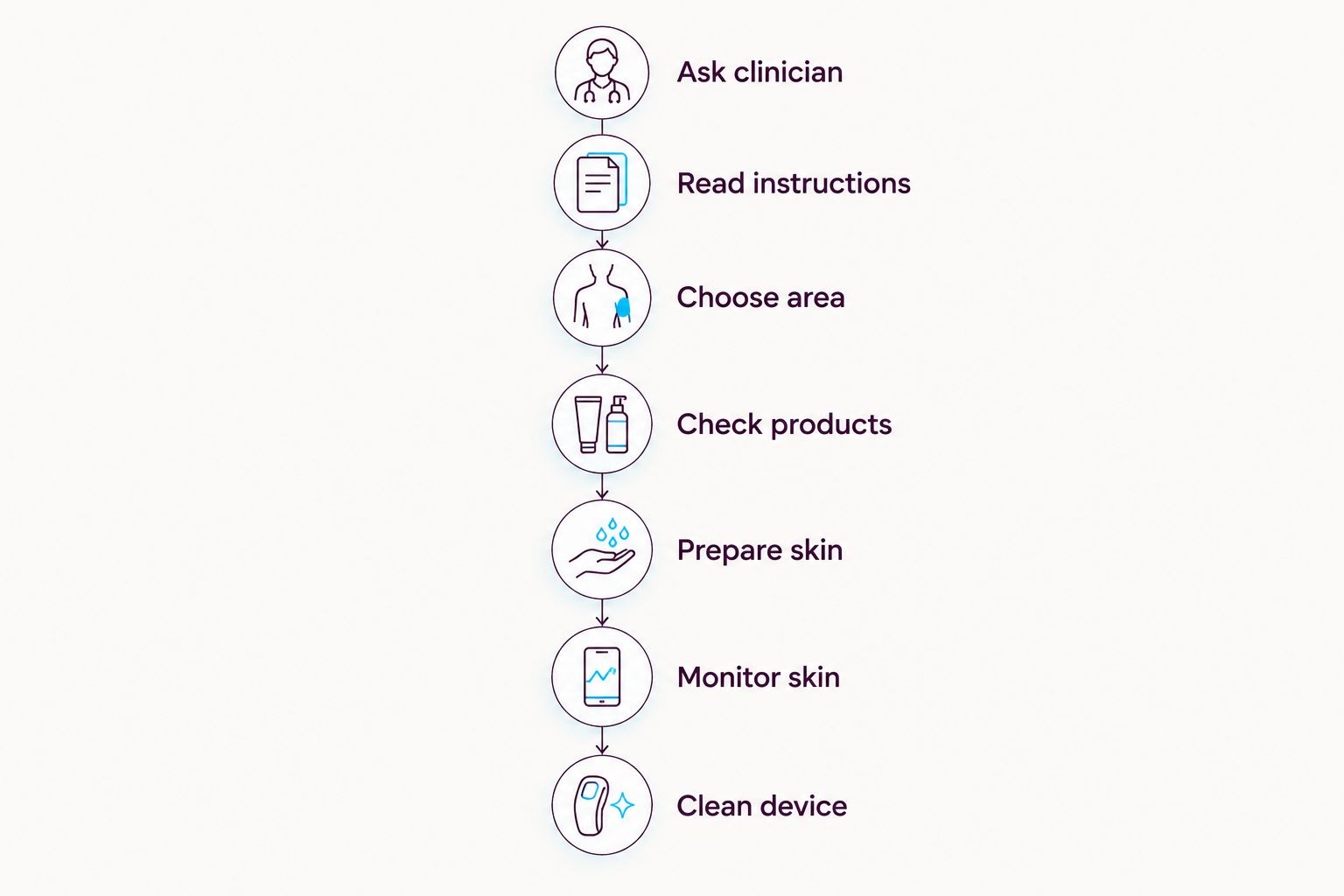
Use a conservative, repeatable process. The seven steps below separate the device decision from the medical and skincare questions that determine whether a session is appropriate.
Tell your clinician which body area you plan to treat, which device you intend to use, and which topical products will touch your skin. Mention prescription drugs, over-the-counter medications, supplements, recent procedures, and any history of light sensitivity.
Do not rely on general reassurance about LED skincare. Your own medical history determines whether red light therapy while breastfeeding belongs in your 2026 routine.
Use only the session duration, frequency, treatment distance, and eye protection stated by the manufacturer. Do not copy another device's routine; output, wavelengths, treatment design, and intended use vary.
Visible red light commonly falls between 620 and 750 nanometers. Near-infrared light begins around 750 nanometers and extends to approximately 1,400 nanometers under standard spectrum classifications. Those ranges explain the light category, not the specifications or safety profile of a particular device.
Choose a face-focused treatment area unless your clinician specifically approves something else. Do not place a face, neck, or chest device over breast tissue, the nipples, engorged areas, a clogged duct, or skin affected by suspected mastitis.
A handheld option gives you more control over the treatment area. The 4-in-1 Radiant Renewal Skincare Wand with Red Light Therapy can be directed across the face and jawline while staying away from the nursing area. Its limitation is that correct use still depends on following its instructions and receiving personal medical clearance.
Red light therapy and skincare products are two separate safety decisions. A serum, cream, acne treatment, prescription topical, or medication may carry a breastfeeding restriction or increase sensitivity to light even when the LED device itself does not.
Review active ingredients with your clinician or pharmacist. The National Library of Medicine's LactMed database is also designed to summarize information about drugs and breastfeeding, but it does not replace advice based on your full medication list.
Do not use the device over open wounds, a healing incision, unexplained swelling, an active rash, or infected skin unless a clinician directs you to do so. Follow the device instructions for skin preparation; do not assume that every mask or wand requires the same serum or cream.
Keep treatment separate from feeding. This prevents the device, cords, and freshly applied skincare products from contacting your baby during a session.
Stop the session if you develop pain, marked redness, swelling, blistering, dizziness, an eye complaint, or another unexpected response. Persistent symptoms need clinical review before you use the device again.
Do not increase session length or frequency to compensate for missed treatments. More exposure is not automatically more effective, and the safe limit comes from the instructions for your specific device.
Clean the contact surface exactly as directed after use. Store the device, charging cable, cleaning products, and topical formulas outside your baby's reach.
Do not improvise with a household cleaner unless the manufacturer identifies it as compatible. The wrong cleaner can leave residue on a surface that later touches your skin.
The best format minimizes contact with the nursing area and makes it easy to stop when your baby needs you. No format eliminates the need to check the manual and ask your clinician.
| Format | Best for | Pros | Cons |
|---|---|---|---|
| Handheld facial wand | Targeted facial treatment | Precise placement; easy to keep away from breasts and nipples | Requires active handling and consistent technique |
| LED face mask | Hands-free facial treatment | Covers a larger facial area in one routine | Must fit correctly; eye guidance and device instructions still apply |
| Neck and chest mask | Décolletage treatment after medical clearance | Designed for the neck and chest area | Sits close to breast tissue and is not the first choice during engorgement, mastitis, or breast tenderness |
Solawave is best for breastfeeding users who have clinician approval and want face-focused at-home red light therapy; skip chest-area treatment unless your clinician clears it. That verdict balances the practical benefit of a targeted facial device against the absence of breastfeeding-specific clinical evidence.
A handheld wand offers control, but it occupies one hand. A mask leaves your hands free, but you should not use it while holding or feeding your baby. Pick the format that lets you follow the full session safely rather than the one that promises the most coverage.


No single answer fits every nursing parent. These factors change the decision:
A device that felt comfortable before pregnancy may not feel the same postpartum. Treat a change in tolerance as useful information, not something to push through.
Red light is energy, not a chemical ingredient, so it does not transfer into breast milk in the same way a medication can. However, limited breastfeeding-specific research means there is not enough evidence to promise that every wavelength, device, treatment area, and routine is risk-free.
The practical 2026 rule is simple: keep treatment away from breast tissue and get personal clearance. Do not use red light therapy as a treatment for low milk supply, engorgement, clogged ducts, nipple damage, or mastitis unless a qualified clinician is directing that care.
There is no established evidence that facial red light therapy reduces milk supply. Milk production is regulated by hormonal signaling and milk removal, but a lack of reported harm is not the same as proof across every device and treatment protocol.
If your supply changes, contact a lactation consultant or clinician. Do not change feeding frequency or use a light therapy device to address supply without professional guidance.
Do not use a device while actively breastfeeding or holding your baby. A hands-free mask still introduces bright light, straps, skincare residue, charging equipment, and the chance that you will need to remove the device quickly.
Schedule the session after a feed, place your baby in a safe location, and complete the routine without divided attention. This is a handling recommendation, not a claim that reflected red light contaminates breast milk.
Pause breast, neck, and chest treatment and contact a clinician if you have breast pain, warmth, swelling, redness, fever, or flu-like symptoms. Mastitis can require prompt medical treatment, and a consumer skincare device should not delay diagnosis.
A face-focused routine may still be inappropriate if you feel unwell or are taking a medication that changes light sensitivity. Resume only after your clinician reviews the device and confirms that the treatment area is acceptable.
Is red light therapy safe while breastfeeding in 2026?
Red light therapy while breastfeeding should be used only after a qualified clinician approves your device, treatment area, medications, and skincare products. Breastfeeding-specific safety evidence remains limited in 2026, so avoid direct treatment of the breasts and nipples.
Can I use an LED face mask while breastfeeding?
You can consider an LED face mask after your clinician clears it and you review the manufacturer's contraindications. Use it on intact facial skin, follow the eye-protection guidance, and do not wear it while feeding or holding your baby.
Can I use a red light therapy wand while breastfeeding?
A red light therapy wand can be considered for targeted facial use after medical clearance. Keep it away from breast tissue, follow the specified session instructions, and stop if you develop an unexpected skin or eye reaction.
Should I use red light therapy on mastitis?
Do not use a consumer red light therapy device to treat suspected mastitis unless a qualified clinician directs the treatment. Breast pain, warmth, swelling, redness, fever, or flu-like symptoms require prompt medical assessment.
Does red light therapy pass into breast milk?
Red light does not pass into milk as a chemical substance because it is light energy rather than a drug. That fact does not replace device-specific safety review or breastfeeding-specific clinical evidence.
Can skincare serum used with red light therapy affect breastfeeding?
A serum requires a separate breastfeeding safety check because its ingredients can be absorbed through the skin. Review the full ingredient list with your clinician or pharmacist before combining it with a light therapy device.
Do I need eye protection for red light therapy?
Use the eye protection stated in your device instructions. Do not assume that closing your eyes is enough when the manufacturer requires goggles or another protective method.
When should I stop a red light therapy session?
Stop if you experience pain, marked redness, swelling, blistering, dizziness, an eye complaint, or another unexpected symptom. Seek medical guidance before restarting the device.
The device is only half of the safety check. A 2026 breastfeeding routine can pair a suitable facial device with an unsuitable topical, or use a familiar product on newly sensitive postpartum skin.
Write down the device name, treatment area, medications, and complete skincare ingredient lists before speaking with your clinician. That turns a vague safety question into a decision based on the exact Solawave red light therapy device and products you plan to use.
 Acne
Acne

