

Rated 4.7 out of 5 stars
4.7 / 5


726,000+ customers
Free 60-Day Returns
1-Year Warranty
726,000+ customers
Free 60-Day Returns
1-Year Warranty
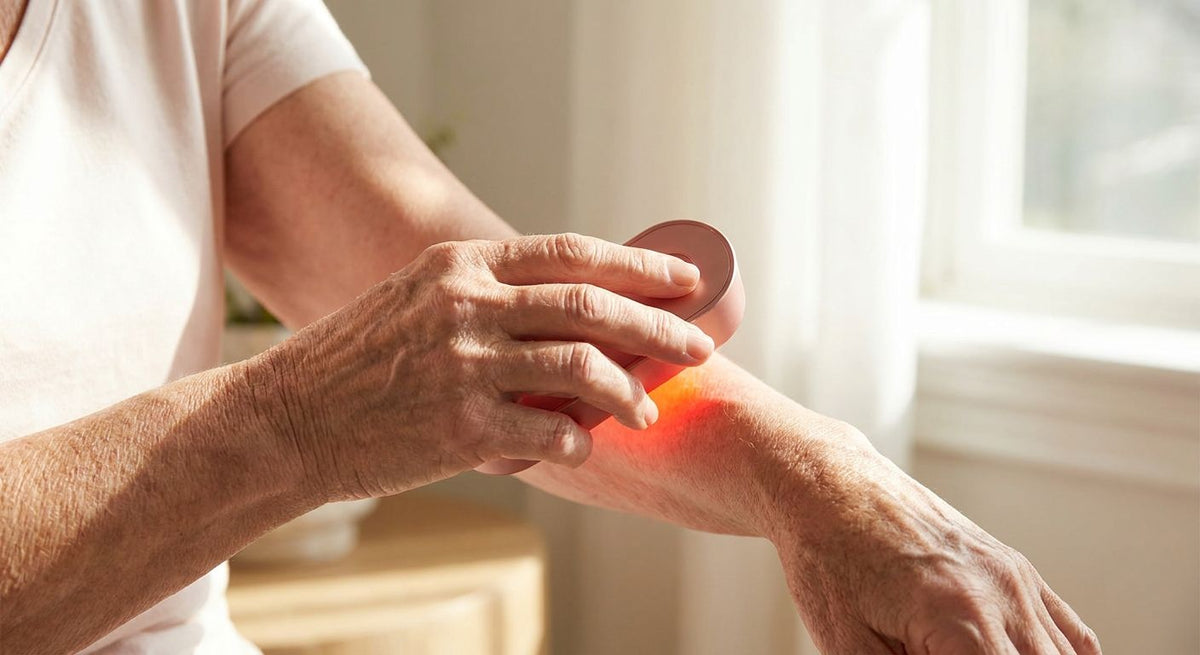
Red light therapy for crepey skin works on the thin, crinkled texture that shows up on the neck, chest, under-eyes, and upper arms as collagen and elastin production slow down, with the goal of firming and smoothing that tissue without needles or downtime. Crepey skin behaves differently from fine lines or breakouts: it needs near-infrared wavelengths that reach deeper into the dermis, not the surface-level red light aimed at a single wrinkle or blemish.
Crepey skin happens when the epidermis thins and the elastin fibers underneath lose their spring, usually from a mix of age, cumulative sun exposure, and — for a lot of people — the collagen decline that comes with menopause. It shows up as a crinkled, tissue-paper texture rather than a defined line, which is why generic anti-aging advice aimed at forehead lines or crow's feet doesn't always translate to this segment.
The fix isn't erasing one line. It's stimulating fibroblasts across a wider, thinner stretch of skin — the neck, the chest, the under-eye area, sometimes the upper arms. A device like the Solawave Wrinkle Retreat Pro LED Face Mask is built around that broader coverage instead of a single targeted spot, which matters more for crepey texture than for one wrinkle or blemish.
The Solawave Neck & Chest Pro Light Therapy Mask exists because décolletage skin is thinner than facial skin and takes sun exposure nearly every day, yet most routines stop at the jawline.
“Red light therapy for crepey skin only earns results if the near-infrared wavelength reaches skin thinner than the face, which is why the neck and chest need their own device instead of overflow from a facial mask.”
The Solawave 4-in-1 Radiant Renewal Skincare Wand works for zones a full mask can't target precisely — under-eyes, jawline, the sides of the neck.


| Option | Best For | Key Limitation |
|---|---|---|
| Daily SPF + retinoid routine | Preventing further crepey texture | Doesn't rebuild collagen already lost — slows decline, doesn't reverse it |
| At-home LED face mask (red + near-infrared) | Full-face crepey texture and cheek or forehead sagging | Skips the neck, chest, and under-eye zones outside mask coverage |
| Handheld red light wand | Spot treatment, under-eyes, jawline contouring, travel | Manual coverage takes longer than a hands-free mask |
| Dedicated neck & chest LED mask | Décolletage crepey skin specifically | Doesn't treat the face — usually paired with a facial device |
| In-office laser resurfacing | Severe, longstanding crepey texture | Requires recovery downtime; not a repeatable weekly routine |
Verdict: at-home light therapy wins on consistency; in-office treatment wins on severity. Most crepey skin cases in 2026 respond to the at-home route if you stay consistent for months, not weeks.
What causes crepey skin?
Crepey skin comes from thinning of the epidermis and breakdown of elastin fibers, driven by age, cumulative sun exposure, and hormonal shifts like menopause. It shows up as a crinkled, tissue-paper texture rather than a defined line.
Does red light therapy work for crepey skin?
Red and near-infrared light stimulate fibroblast activity that supports collagen production in the dermis, the layer where crepey skin's structural loss happens. Results depend on consistent use over weeks, not a single session.
How long does it take to see results from red light therapy on crepey skin?
Most routines need eight to twelve weeks of consistent use before texture changes are visible in progress photos. Collagen remodeling is gradual, so weekly comparisons usually won't show a difference.
Is red light therapy for crepey skin the same as therapy for wrinkles?
No — wrinkles are single creases treated with spot-focused light, while crepey skin covers a wider, thinner area that needs broader coverage and near-infrared penetration into the dermis. The wavelength combination matters more for crepey skin than for one line.
Can I use a face mask on my neck and chest for crepey skin?
A facial mask's coverage area typically doesn't extend to the neck and chest, so décolletage crepiness needs a dedicated device like the Solawave Neck & Chest Pro Light Therapy Mask. Using a face-only mask on that zone means it's not getting treated at all.
What wavelength is best for crepey skin?
Near-infrared light in the 830-850nm range paired with red light around 630-660nm reaches deeper into the dermis where crepey skin's collagen loss occurs. Devices offering both, plus deep red and amber, cover more of the mechanism than red light alone.
Is red light therapy safe for thin, aging skin?
FDA-cleared at-home red light devices are designed for daily skin use, but thin crepey skin should still be handled gently, without pressing or pulling during application. Pair sessions with sunscreen since thinner skin is more vulnerable to new UV damage.
Does red light therapy for crepey skin work on arms and hands?
The mechanism works the same way on arms and hands as it does on the face and neck, though most at-home devices are shaped for facial or neck use rather than limbs. A handheld wand adapts better to these zones than a fitted mask.
Near-infrared light penetrates deeper into skin than red light alone, which is exactly why it matters more for crepey skin than for concerns sitting closer to the surface, like acne or dark spots. A device offering only red light treats the epidermis; a device combining red, infrared, deep red, and amber — like the Solawave Wrinkle Retreat Pro's four-wavelength setup — reaches the dermis where the collagen that firms crepey skin actually lives. Choosing a device for 2026, the wavelength count matters more than anything else on the spec sheet.
 Acne
Acne

