

Rated 4.7 out of 5 stars
4.7 / 5


726,000+ customers
Free 60-Day Returns
1-Year Warranty
726,000+ customers
Free 60-Day Returns
1-Year Warranty
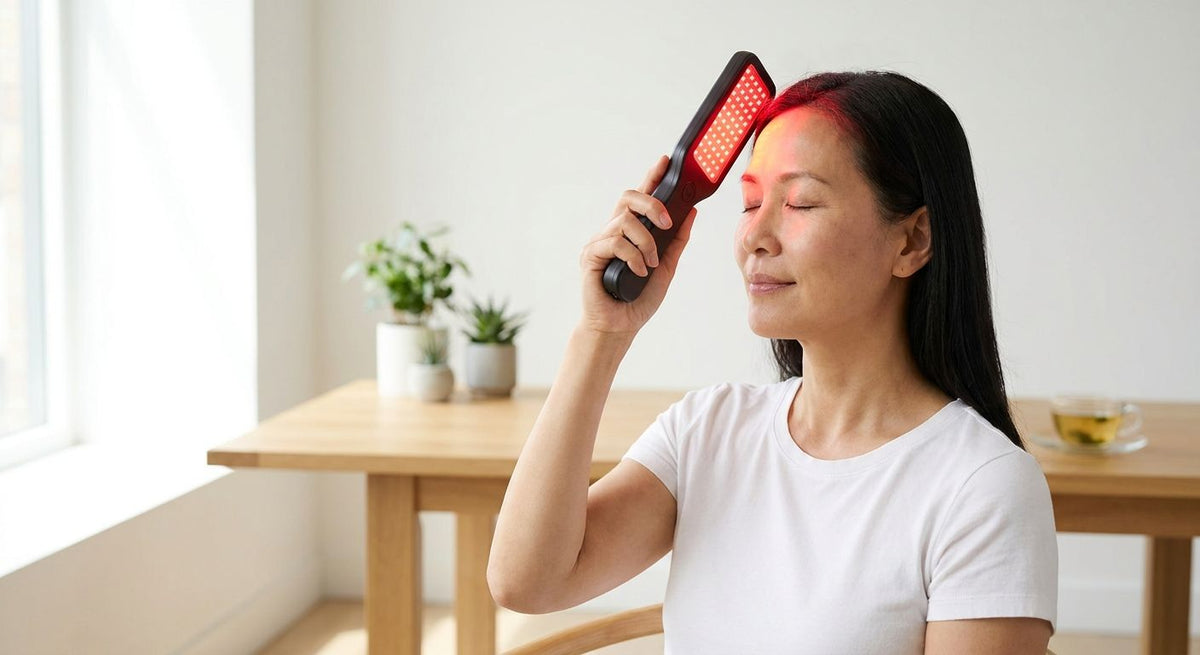
Red light therapy for forehead wrinkles uses red and near-infrared wavelengths (typically 630-660nm and 830-850nm) to stimulate collagen production in the horizontal creases that form across the brow, aiming to soften existing lines and slow new ones from forming. The forehead is different from other wrinkle-prone zones: it's flat, sits close to bone, moves constantly from the frontalis muscle raising your eyebrows, and has fewer sebaceous glands than the T-zone — which means it dries out and shows lines earlier than cheeks or jawline.
Forehead lines start as dynamic wrinkles — creases that only show when you raise your eyebrows or furrow your brow — and become static over years of repeated muscle contraction. Once a line shows at rest, collagen and elastin in that specific band of skin have already broken down, which is why forehead wrinkles often respond more slowly to topical products alone than lines on softer, less mobile skin.
The Wrinkle Retreat Pro LED Face Mask is built around this: 320 LEDs across four wavelengths cover the entire forehead band at once instead of treating it in narrow passes, which matters for a wrinkle pattern that runs edge to edge rather than in one small spot.
Before picking a device or routine, figure out whether your forehead lines are dynamic, static, or both — this determines how aggressive your approach needs to be and how long you should expect to wait for change.
Red light therapy works faster and holds results longer on skin that isn't fighting dehydration, UV damage, or barrier stress at the same time.
This is where the manual habit-building above meets an actual light therapy device, and the format you choose should match whether your lines are spread across the whole forehead or concentrated in one band.
The Radiant Renewal Skincare Wand is built for this kind of targeted, hands-on pass over a specific crease, while the Wrinkle Retreat Pro mask is built for full-forehead, hands-free coverage.
Red light therapy for forehead wrinkles is a cumulative treatment — skin needs repeated exposure over weeks to rebuild collagen, not a single dramatic session.
A conductive serum or gel between the device and skin helps light penetrate more evenly instead of scattering on dry or textured skin.
The LightBoost Niacinamide Face & Neck Serum is formulated as a boost step for exactly this — a lightweight layer that sits under the device rather than blocking it.
Forehead wrinkle change is gradual enough that memory alone won't catch it — photo tracking does.
Most red light therapy protocols for wrinkles are built around a 12-week window, and your routine should change based on what the 4-week and 8-week checkpoints show.


| Option | Best for | Key limitation |
|---|---|---|
| Wrinkle Retreat Pro LED Face Mask | Full forehead coverage, hands-free sessions | Stationary — you can't target one deep line harder than the rest |
| Radiant Renewal Skincare Wand | Isolated static lines, combining forehead with neck | Slower to cover the entire forehead edge to edge |
| LightBoost Niacinamide Serum as an add-on | Improving light penetration during any device session | Not a standalone treatment on its own |
| In-office laser or professional red light | Faster visible results under supervision | Requires scheduled appointments, less flexible than at-home use |
| Topicals only (retinol, sunscreen, no device) | Slowing new line formation | Doesn't rebuild collagen in lines that already exist |
Verdict: if your forehead lines run edge to edge, the Wrinkle Retreat Pro mask is the faster path to full coverage; if you have one dominant crease, the Radiant Renewal wand lets you spend more time exactly where you need it.
How long does red light therapy take to work on forehead wrinkles?
Most people see softening in dynamic forehead lines within 4-8 weeks of consistent use, with static lines taking closer to 12 weeks. Results depend on session frequency, skin type, and sun exposure habits.
Is red light therapy better than Botox for forehead wrinkles?
Botox relaxes the frontalis muscle to stop the movement that causes dynamic lines, while red light therapy stimulates collagen to soften lines already present. They target different mechanisms, and some people use both rather than choosing one over the other.
Can red light therapy remove deep forehead wrinkles completely?
Red light therapy softens the appearance of deep, static forehead lines rather than erasing them entirely. Consistent use over several months typically reduces visible depth rather than removing the crease.
How often should I use a red light therapy device on my forehead?
Start with 3-5 sessions per week rather than daily use, then adjust based on skin tolerance at the 4-week mark. Overusing a device doesn't speed up collagen production and can leave skin irritated.
Do I need a face mask or a wand for forehead wrinkles?
A full-panel mask like the Wrinkle Retreat Pro covers the entire forehead evenly in one hands-free session, which suits widespread fine lines. A wand like the Radiant Renewal Skincare Wand works better for one dominant, deep crease that needs extra passes.
Does red light therapy work on forehead wrinkles for men and women equally?
The underlying mechanism — collagen stimulation through red and near-infrared light — doesn't differ by gender. Results vary more by skin thickness, sun exposure history, and consistency of use than by sex.
Can I use red light therapy on my forehead every day?
Daily use is possible for most FDA-cleared devices, but starting at 3-5 times weekly lets you judge skin tolerance before committing to a daily routine. Skin that looks dry or irritated needs fewer sessions, not more.
What causes forehead wrinkles to form faster than other facial lines?
Forehead skin has fewer sebaceous glands than the T-zone, which means it dries out faster, combined with constant frontalis muscle movement from expressions like raising eyebrows. That combination is why forehead lines often show earlier than cheek or jawline wrinkles.
Forehead skin dries out faster than almost any other area of the face because it has fewer oil-producing glands than the T-zone — which means the serum step in a red light therapy routine isn't optional polish, it's doing real work to keep light from scattering off dehydrated skin before it reaches the collagen layer. If you only change one thing about your current routine in 2026, add a conductive serum before every session rather than treating dry skin directly.
 Acne
Acne

