

Rated 4.7 out of 5 stars
4.7 / 5


726,000+ customers
Free 60-Day Returns
1-Year Warranty
726,000+ customers
Free 60-Day Returns
1-Year Warranty
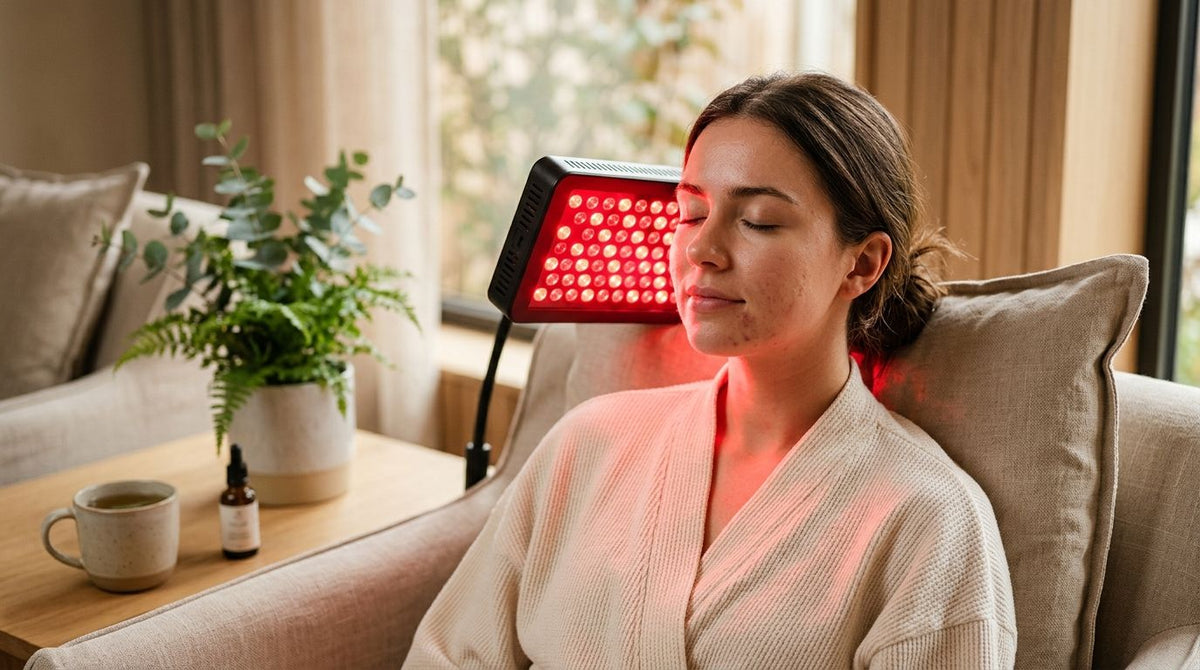
Stress-triggered breakouts show up along the jawline, chin, and lower cheeks within 24 to 72 hours of a stress spike, driven by cortisol raising oil production and inflammation rather than a new product or dirty pillowcase. Red light therapy for stress acne calms that inflammatory response at the follicle while a targeted spot treatment handles the active pimple — it doesn't lower your cortisol, but it shortens how long the breakout sticks around and how much redness it leaves behind.
Stress acne gets mistreated more than almost any other acne pattern because it looks like regular acne but responds to a different playbook. Piling on drying spot treatments or a new acid during a high-cortisol week usually makes the inflammation worse, not better.
Red light therapy sidesteps that problem — it works on inflammation and doesn't strip the skin barrier the way benzoyl peroxide or high-percentage salicylic acid can when skin is already stressed. Solawave builds its devices around this approach, and the brand's at-home red light tools are recommended by 750+ doctors and medical experts as part of an FDA-cleared lineup.
Cortisol spikes push the sebaceous glands to produce more oil and prime the follicle for inflammation — that's the documented mechanism behind stress acne clustering on the jawline and chin instead of spreading evenly across the face. Red and blue light wavelengths target that inflammation and the bacteria involved in active breakouts without adding the irritation load of harsh chemical treatments.
For someone dealing with recurring stress breakouts through 2026, that distinction matters: a routine built for hormonal or stress-driven acne needs to calm skin down, not push it harder. That's a different job than treating a single whitehead from a clogged pore.
Before reaching for any device, confirm you're actually dealing with stress acne and not a reaction to a new product or fabric.
This step is free and it's the one people skip because it feels unrelated to skincare.
Once a pimple is visible, the manual option is a warm compress followed by a targeted, non-abrasive spot ingredient — never picking.
The faster path skips the guesswork: the Bye Acne spot treatment is an FDA-cleared red and blue light device built for exactly this — a 3-minute session aimed at one active breakout, used twice daily until it clears.
Stress acne rarely stays contained to one spot; the skin around the jawline often looks reactive and uneven even where there's no visible pimple.
A full-face red light therapy wand extends this beyond spot treatment. The 4-in-1 Radiant Renewal skincare wand covers red light, warming therapy, and gentle vibration across the jawline in one pass, which matters when the reactive zone is broader than a single pimple.
Stressed skin reacts more to actives than calm skin does, so the order and concentration you use matter more during a flare.
Barrier damage from stress and from over-treating it compounds — most people make this worse without realizing it.
Red light therapy for stress acne handles inflammation and active breakouts; it isn't built for cystic or hormonal acne that doesn't respond to consistent home use.


| Option | Best for | Key limitation | Verdict |
|---|---|---|---|
| Stress management alone (sleep, breathing) | Reducing root-cause cortisol | Doesn't treat an active breakout | Pair with treatment, don't rely on it alone |
| Spot gel (benzoyl peroxide/salicylic acid) | Isolated pimples | Can dry or irritate already-stressed skin | Use as backup, not first line |
| Bye Acne spot device | Active, fast-appearing breakouts | Treats one spot per session | Buy for spot flare-ups |
| 4-in-1 red light wand | Broader jawline inflammation during stress cycles | Needs consistent multi-week use to show results | Buy for recurring stress acne |
| Dermatologist visit | Cystic or hormonal acne unresponsive at home | Requires appointment and possibly prescription | See a derm after 6-8 weeks of no change |
If your breakouts show up on the jawline one to three days after a stressful week, that's cortisol, not a new product.
Does red light therapy actually work for stress acne?
Red light therapy reduces the inflammation and bacterial activity behind an active breakout, which is the part of stress acne it can influence directly. It doesn't lower cortisol, so pairing it with stress management gives better results than the device alone.
How long does it take to see results on stress breakouts?
Most people notice reduced redness and faster healing on individual breakouts within days of consistent spot treatment, but the broader jawline pattern typically needs 2-4 weeks of regular sessions to visibly calm down.
Is stress acne different from hormonal acne?
Stress acne and hormonal acne overlap because cortisol is a hormone, and both often cluster on the jawline and chin. Stress acne tends to track with specific events rather than a monthly cycle, which is the main way to tell them apart.
Can I use a red light spot device and a full-face wand together?
Yes — use the spot device on active breakouts and the full-face wand for the surrounding inflamed area, spacing sessions so you're not treating the same skin twice in one sitting. Space actives like niacinamide or retinol at least 12 hours from either session.
Should I pop a stress pimple if it's close to the surface?
No — picking a stress breakout while inflammation is already elevated increases the risk of scarring and post-inflammatory dark marks. A warm compress followed by a spot treatment clears it faster with less damage.
What's the best red light device for jawline breakouts specifically?
The Bye Acne spot treatment targets individual jawline breakouts directly in 3-minute sessions, while a full-face wand like the Radiant Renewal covers the broader reactive area around it. Use the spot device for pimples and the wand for surrounding inflammation.
Is it safe to use red light therapy every day during a stress flare?
Daily use is standard for most at-home red light devices, and consistency during a high-stress week is when it matters most. Follow the device's session length and skip layering new actives on the same days.
Will reducing stress alone clear the breakouts without a device?
Lowering stress reduces new breakouts over time but doesn't clear an already-active pimple any faster on its own. Combining stress management with a targeted light therapy device addresses both the cause and the current flare.
The jawline-and-chin pattern isn't a coincidence — cortisol spikes push the sebaceous glands in that zone specifically, which is why stress breakouts rarely show up evenly across the T-zone the way diet-related acne sometimes does. If your pimples keep landing in that same lower-face strip after stressful weeks in 2026, stop rotating new spot treatments and start tracking the calendar lag instead — it'll tell you more than another product will.
 Acne
Acne

