

Rated 4.7 out of 5 stars
4.7 / 5


726,000+ customers
Free 60-Day Returns
1-Year Warranty
726,000+ customers
Free 60-Day Returns
1-Year Warranty
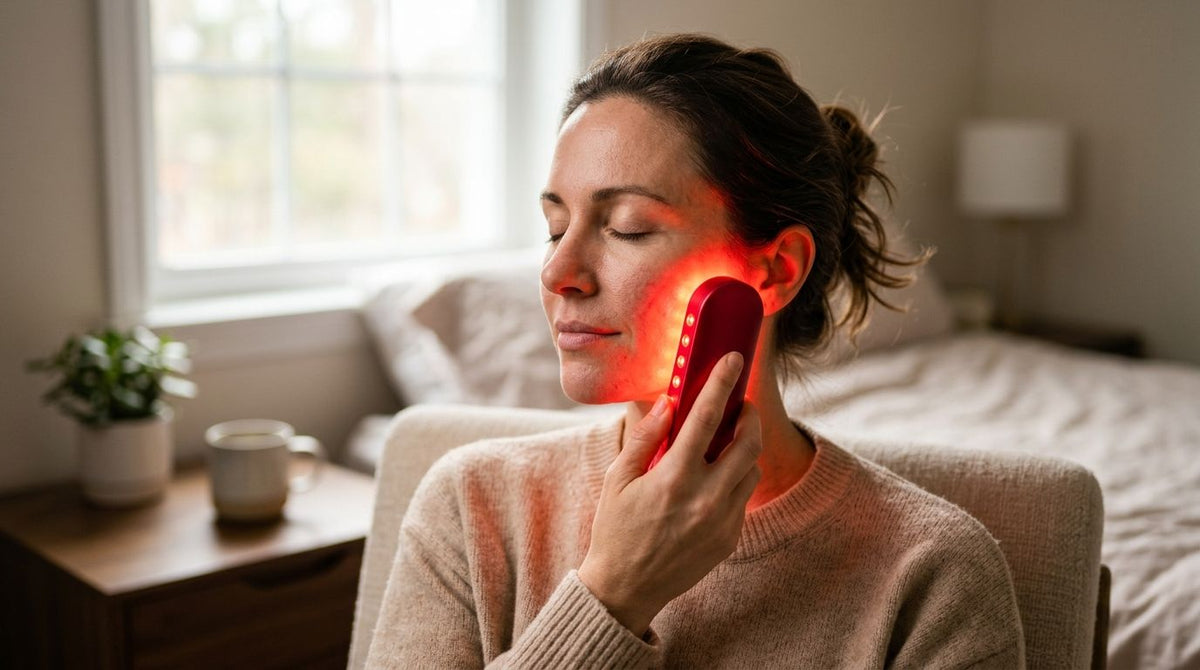
Uneven skin texture responds to red light therapy by reducing surface inflammation and pushing collagen turnover, which smooths bumps, roughness, and shallow scarring without harsh exfoliants or downtime. Unlike a pure anti-aging routine, texture correction usually means treating a mix of causes at once: clogged pores, old acne marks, dehydration lines, and sun-roughened patches, so the protocol has to work on several fronts instead of one.
Texture problems don't come from one source, which is why generic anti-aging advice underperforms for this group. Someone dealing with post-acne bumps, enlarged pores, and rough patches from sun exposure needs a treatment that calms active inflammation while also supporting the collagen that fills in shallow depressions.
Red and near-infrared wavelengths penetrate the dermis and stimulate fibroblast activity, the cells responsible for producing new collagen and elastin. For texture specifically, this matters more than for pure wrinkle reduction because texture is a surface irregularity problem — collagen fill smooths the terrain rather than just lifting a fold.
The segment searching for red light therapy for uneven skin texture in 2026 is typically past the acne-active stage and dealing with the aftermath: shallow scarring, enlarged pores, rough patches, or a combination of all three. That separates this group from people chasing forehead wrinkles or under-eye puffiness — the fix has to address several texture types in one routine.
Not all uneven texture responds the same way, so treating it correctly starts with naming the problem.
A damaged barrier makes every texture issue worse because inflamed, dry skin reflects light unevenly and resists collagen-building treatments.
Texture correction responds better to frequency than to session length. The 4-in-1 Radiant Renewal Skincare Wand delivers red light along with warming massage and gentle vibration, which suits texture routines that also want circulation support.
Dry skin exaggerates every texture flaw. A serum applied before red light exposure helps the device glide and supports the skin's ability to hold onto hydration.
Pores are a texture issue with their own rules — they don't shrink permanently, but their appearance can be minimized with consistent care.
Post-acne scarring responds slower than surface roughness because it involves deeper collagen loss. A full-face LED mask like the Wrinkle Retreat Pro LED Face Mask distributes red and infrared light across scarred and unscarred areas at once, so results don't come out patchy.
Texture changes are gradual, and memory alone won't catch subtle improvement.
| Option | Best for | Key limitation |
|---|---|---|
| Handheld red light wand | Spot treatment on pores, scars, targeted areas | Requires manual technique and daily consistency |
| Full-face LED mask | Hands-free even coverage for roughness and dullness | Needs a dedicated session with no multitasking |
| Chemical exfoliants (AHA/BHA) | Surface flakiness and dullness | Can irritate already-inflamed texture if overused |
| Professional microneedling | Deeper, pitted scarring | Requires downtime and repeat clinic visits |
| Topical retinoids | Long-term collagen support | Slow onset, often 3-6 months for visible change |


A handheld wand wins for spot work on pores and isolated scarring, while a full-face LED mask wins for broad roughness — most 2026 texture routines run one of each rather than picking a single device.
“Texture rarely stays where you see it, which is why full-face treatment beats spot treatment almost every time.”
Does red light therapy actually fix uneven skin texture?
Red light therapy improves texture by stimulating collagen production and reducing inflammation, which smooths shallow scarring, roughness, and pore appearance over 8-12 weeks of consistent use. It does not remove deep pitted scarring the way in-office procedures can.
How long before red light therapy improves texture?
Most people see smoother texture after 8-12 weeks of regular sessions, because collagen remodeling is gradual. Consistency matters more than session length for texture specifically.
Is a red light wand or an LED mask better for uneven texture?
A handheld wand suits targeted areas like pores or isolated scarring, while a full-face LED mask gives even coverage for broader roughness. Many 2026 routines use both, depending on where the texture is concentrated.
Can red light therapy help with enlarged pores?
Red light therapy can improve how enlarged pores look by supporting collagen around the pore opening and calming surrounding inflammation, though it does not permanently shrink pore size. Consistent hydration alongside treatment improves the visual result.
Should I exfoliate before or after red light therapy?
Cleanse gently before a session and keep exfoliating acids off the skin on treatment days to reduce irritation risk. Schedule chemical exfoliation on separate days in your weekly routine.
Does red light therapy work on post-acne scarring?
Red light therapy softens the look of shallow post-acne scarring by encouraging collagen fill, usually needing 8-12 weeks or longer for visible change. Deeper pitted scarring generally needs red light plus a professional treatment.
What serum works best with red light therapy for texture?
A lightweight hydrating serum with niacinamide or hyaluronic acid applied before the session supports glide and hydration without blocking light penetration. Heavy occlusive creams are better saved for after the session.
Can uneven texture from dryness be treated with red light therapy?
Yes, red light therapy paired with consistent hydration reduces the crepey, flaky look that dryness causes, since inflammation control and barrier support work together. The hydration step matters as much as the device step for this texture type.
The first texture change most people notice isn't smoothness — it's how light reflects off the skin. Rough, uneven surfaces scatter light unevenly, which is why photos under harsh lighting look worse than the mirror does. As collagen fills in over the first 8-12 weeks of a 2026 red light routine, that scatter evens out before the skin actually feels different under your fingertips. Judge progress by photos, not by touch.
 Acne
Acne

